
by Peter Wetherbee
"Ambient music is a genre of music that puts an emphasis on tone and atmosphere over traditional musical structure or rhythm. Ambient music is said to evoke an "atmospheric", "visual",or "unobtrusive" quality. According to Brian Eno, one of its pioneers, "Ambient music must be able to accommodate many levels of listening attention without enforcing one in particular; it must be as ignorable as it is interesting." (Wikipedia)
The ever-brilliant Bruce Sterling, in his early nov Schismatrix, describes a futuristic musical instrument that resembles a cross between a digital sampler and a synthesizer. Sterling seems unable to resist a little editorializing which could be relevant to the use of samplers in contemporary ambient, among other genres: An artificial morning shone through false glass doors. Kitsune sat in thought, toying quietly with the keys of her synthesizer.
"Her proficiency had long since passed the limits of merely technical skill. It had become a communion, an art sprung from dark intuition. Her synthesizer
could mimic any instrument and surpass it: rip its sonic profile into naked wave forms and rebuild it on a higher plane of sterilized, abstract purity. Its music had the painful, brittle clarity of faultlessness.
Other instruments struggled for that ideal clarity but failed. Their failure gave their sound humanity. The world of humanity was a world of losses, broken hopes, and original sin, a flawed world, yearning always for mercy, empathy, compassion... "
About midway through Walter Mosley's [new] novel Blue Light, protagonist Chance drinks the blood of his mentor Orde, whose own blood has been tran formed by exposure to a magical blue light from outer space.1
"When I woke up again it was night and I was alone.
The room I was in was large with a high domed ceiling. There was a big white door that must've led to some hallway, and then there were double glass doors, covered in white lace, that went outside.
The moon was shining through the curtains. I forced myself to stand up and walk to the glass doors. I didn't feel strong enough to pull them open, but I moved the curtains to the side and gazed up at the moon. I can't express the joy that I felt looking up, being filled with light. Even the comparatively sterile light of the moon is filled with wonderful truths. With my heightened senses, I could actually feel the light against my skin. The tactile sensation
caused slight frictions along my nerves. It was like the diminishing strain of a classical composition that had gotten so soft a breeze could have erased it.
The music spoke of that spinning celestial body and of the sun's heat. There was a long-ago cry of free-forming gases and a yearning for silence. The universe, I knew then, was alive. Alive but still awakening. And that awakening was occurring inside my mind. I was a conduit. We were all conduits. With my mind I could reach out to the radiance that embraced me. But I didn't understand. I wasn't blessed by light. The potion Orde gave me opened my senses but gave me precious little knowledge. I was like the tinfoil put on a jury-rigged coat-hanger antenna -- merely a convenience, an afterthought with few ideas of my own.
The universe spoke to me in a language that was beyond my comprehension. But even to hear the words, just to feel them, filled me with a sense of being so large that I couldn't imagine containing any more."
Chance wakes up and immediately makes an assessment of the physical space around him. Mosley's prose throughout is sparse yet full of pure Ambiance in description through Chance's perception. The dimension and shape of the room, the reflective and absorptive surfaces of glass and lace curtain, and even an intuitive speculation about what kind of space lies beyond the door, are all quickly acknowledged in Chance's moment of waking.
The experience with the moonlight -- which draws him magnetically to the window, in spite of his physical difficulty -- involves an ecstatic response to the power and beauty of the light itself. The light waves "fill him up," however, in a way that is more than merely metaphorical: he continues by describing the physical sensation of light on his skin, which immediately translates into an extended "friction" throughout his autonomous nervous system. So far, Chance's experience has been a textbook Ambient experience with the requisite spatial, textural, and trance elements. Mosley and Chance, however, feel that in order to fully convey the abstract beauty, joy, and power of the experience, it is necessary to describe it in terms of music and the sounds of the universe, which brings the whole scenario into deep Ambient.2
It would be gratuitous to over-analyze Mosley's poetic writing, which certainly speaks eloquently of the cosmos. There is, however, a nice irony to Chance's confusion at the incongruity of the depth and power of his experience not corresponding to what he is supposed to "know." His antenna analogy is no mistake, either -- both of these pieces describe the power of the body to perceive and conceive somatically, in profound ways that transcend mere intellect -- as he tunes in to the vibrations of the universe and has a massive epiphany. Chance's highly Ambient experience speaks more to his body than his mind, which can sense the ecstasy but not grasp it fully.
The reception and understanding of cosmic information was a hot subject in the early centuries after Christ. Iamblichus of Chalcis was a writer and philosopher who lived in the 3rd and 4th Centuries AD, and whose historic weakness was a fascination with "pagan" rituals and beliefs, which he attempted to reconcile with the all-important Platonic/Pythagorean tradition. In the following passage, Iamblichus documents the powers of Pythagoras to hear the music of the cosmos and use music to affect the psyches of others. It is interesting to note that the following translation from the Greek was made in the early 19th Century, separated, therefore, by roughly fifteen hundred years from the original writing. Furthermore, the magic and knowledge espoused by Pythagoras is speculated (by scholar extraordinaire Joscelyn Godwin, among others) to originate in Egyptian and Babylonian practices which easily date that same amount earlier, i.e. the 2nd millenium B.C. (!) The timelessness, beauty, and resonant truth of Ambient and its manifestations has been essential study for no few milennia, and we tread no new ground, but hope, as always, to underscore the sublime. This bit of wisdom speaks to Chance's inability to "understand" the cosmic information as it "explains" some of what he felt, standing in the window. It also tells the same story that most ecstatic or meditative musicians will tell when asked from whence comes thy creativity?
"[Pythagoras devised techniques for curing people by] divinely contriving mixtures of certain diatonic, chromatic, and enharmonic melodies, through which he easily transferred and circularly led the passions of the soul... through certain peculiar songs and modulations, produced either by simply striking the lyre, or employing the voice...he extended his ears, and fixed his intellect in the sublime symphonies of the world, he alone hearing and understanding, it appears, the universal harmony and consonance of the spheres, and the stars that are moved through them, and which produce a fuller and more intense melody than any thing effected by mortal sounds."
This melody also was the result of dissimilar and variously differing sounds, celerities, magnitudes, and intervals, arranged with reference to each other in a certain most musical ration, and thus producing the most gentle, and at the same time variously beautiful motion and convolution...Just indeed, as to those who are incapable of looking intently at the sun, through the transcendent splendor of his rays we contrive to exhibit the eclipses of that luminary, either in the profundity of still water or through the melted pitch, or through some darkly-splendid mirror; sparing the imbecility of their eyes and devising a method of representing a certain repercussive light, though less intense than its archetype, to those who are delighted with a thing of this kind...Sometimes, also, by musical sounds alone, unaccompanied with words, [the disciples of Pythagoras] healed the passions of the soul and certain disease, enchanting, as they say, in reality. And it is probable that from hence this name "epode," i.e. enchantment, came to be generally used.
It seemed for a moment that Mosley had done me the disservice of condensing my entire book into a few paragraphs of succinct and sublime prose. While his vignette encapsulates most of the key aspects of Ambient encounter, the ancient story of Plutarch reminds me that there are more questions. Some are echoed, if not answered, below, where Mosley picks up on the theme of music much later in the book. Juan Thrombone is a post-human wise man who expounds capriciously like Castaneda's Don Juan on the subjects of life, the universe, humanity, and even pop music:
"All the world is music, you see. There is music in atoms and music in suns. That is the range of a scale that you can see and read. There is music in emptiness and silence between. Everything is singing all the time, all the time. Singing and calling for what is missing. Your science calls it gravity, but the gods call it dance. They dance and fornicate; they listen and sing. They call to distant flowers when buds ring out. Because, you see, it is not only atoms and suns that vibrate in tune. Rocks sing, as do water and air. The molecules that build blood and men also build the wasp; these too sing a minor note that travels throughout the stars. Greedy little ditties that repeat and repeat again and again the same silly melodies. They change, but very slowly, chattering, 'me me me me me me me me me....'" He repeated the word maybe a hundred times, lowering his head to the ground as he did so.
He smiled when he was finished and shook his head sadly. The next instant he was on his feet holding his hands out in the question Why?
"So much boring chatter for one so deep. Of course, the iron atom will say only his name. Water too and even granite or glass. Because iron has only one note; water two, maybe three. But you, my friend, make the violin seem simple. You are a song of the gods in the mouth of a fool. You can't help it. So much promise in one so weak attracts disease."
Man's humanity, of course, pales in the face of pure spirit, and Mosley's "fiction" is merely an echo of wisdom developed thousands of years ago. His discussion of music within and without all things and people is supported perfectly by Pythagoras' discussion of music's essential power to heal and combat the dangers of imbalance.
Juan Thrombone's alleged insult, however, could be a rough koan meant to inspire Chance to higher understanding; by the same token, he could just as easily be complementing his intuitive as he tries to bypass the intellectual. At any rate we are deep in the realm of Ambient.
Frank Herbert is another author of fantastic literature. As such, his freedom from the constrictions of our contemporary consensual "reality" allowed him to write a passage in Heretics of Dune (#5 in the Dune series) which elaborates on something hinted at by Mosley and Pythagoras above. Namely, the significance of preconceived notions in one's perception of ambient elements. Somatic perception by definition bypasses the mind. Intuitive perception bypasses any notions of what is being experienced, and is therefore free of any potentially limiting ideas about what "should," "could," or "is, and gets rid of that pesky "how" as well. For Ambient's strength, power, beauty, and essence lie, again by definition, in what is not right in front of our eyes and ears. The more easily we can let go of the immediate, of "knowing" what we're experiencing, of naming, categorizing, cataloguing, and experientially ghettoizing a given phenomenon, the quicker we get into the flow of things around it. The result of freely experiencing Ambient is an increased, interactive awareness of the cosmic in and around us.
Ambient helps us to get past our own preconceptions by dancing in the space, texture, and trance of, around, within and without the alleged business at hand.
"The smell and taste of the drink Taraza had given him so long ago still tingled in his tongue and in his nostrils. A Mental blink and he knew he could call up the scene entire once more -- the low light of the shaded glow globes, the feeling of the chair beneath him, the sounds of their voices. It was all there for replay, frozen into a time-capsule of isolated memory.
Calling up that old memory created a magical universe where his abilities were amplified beyond his wildest expectations. No atoms existed in that magical universe, only waves and awesome movements all around. He was forced there to discard all barriers built of belief and understanding. This universe was transparent. He could see through it without any interfering screens upon which to project its forms. The magical universe reduced him to a core of active imagination where his own image-making abilities were the only screen upon which any projection might be sense.
There, I am both the performer and the performed!
The Workroom around Teg wavering into and out of his sensory reality. He felt his awareness constricted to its tightest purpose and yet that purpose filled the universe. He was open to infinity.
Taraza did this deliberately! She has amplified me!"
The triggers employed in Ambient are as varied as its defining elements. Ambient has fascinated, mesmerized, scared, and soothed us since before we existed. It has been the secret weapon of musicians, shamans, priests, and fascists; the source of lifelong meditations for monks and factory workers; an essential byproduct of the mechanisms of the Earth and the Universe; and, currently, a form of popular music, overt and out of the closet for the first time since being given a name by Brian Eno in the 1970s.
[ 1footnote: Before we leave the subject of light from outer space, it is worth noting some text I found on the internet regarding a phenomenon called "sonoluminescence": This scientific-sounding word basically translates to "sound into light." The idea is very simple--a small bubble, surrounded by some liquid, is bombarded with sound. Due to the high energies now in the bubble, it starts to luminesce, or produce light. While most people have heard nothing about sonoluminescence, it has great potential in many scientific areas. High on the list for many researchers is its applications to fusion, since it is predicted that as sound bombards a bubble, the temperatures can get so hot as to allow fusion to occur within the bubble.]
[2 footnote: All wave frequency spectral chauvinism aside (and notwithstanding this writer's colorblindness), sound is where we go to describe ambiance as it is found on any level. Different types of waves, such as ocean waves, radio waves, and light waves, metaphorical waves such as waves of emotion, or even the representation of waves in visual imagery, are all described powerfully in terms of sound. There is a universality to sound that makes it irresistible as a tool for describing the sublime, ethereal, abstract, or confusing. Among the "arts," music is the lowest common denominator in terms of cultural sophistication, and the least demanding in terms of awareness. You don't even have to look at or pay attention to -- let alone think about -- music the way you do with the written word, visual art, film, etc. Everybody hears the radio, whether they like it or not, it seeps through as a "subliminal" tool in advertising, and the pure sonic landscape of any environment, urban or rural is inescapable. Even if one is completely deaf, the lower frequencies of the audible spectrum are felt as vibrations and rumblings. One could argue that because the sound spectra is made up of much lower, "coarser," frequencies, it is more easily broken down by the ears, body, and mind than the much higher, finer spectrum of light. The difference between a booming bass drum and a squeaking piccolo, for instance, is "greater," most would probably agree, than the difference between red and blue. But then again, perhaps I am merely a sonic zealot. Or maybe I paid Walter Mosley to take his beautiful description of experience with light into the realm of music and sound.]

Peter Wetherbee is a musician. He has produced albums of spirit music from Haiti, the Philippines, and NYC, and written liner notes for various Gnawa and Jajouka music CDs. As label manager for Axiom/Island/Polygram Records, he worked closely with Bill Laswell on spirit music releases from all over the world. He lives in Ithaca, NY, and his mind is controlled by his cat, Larry. peter_wetherbee@yahoo.com
In the Cards
by Annie Cambell
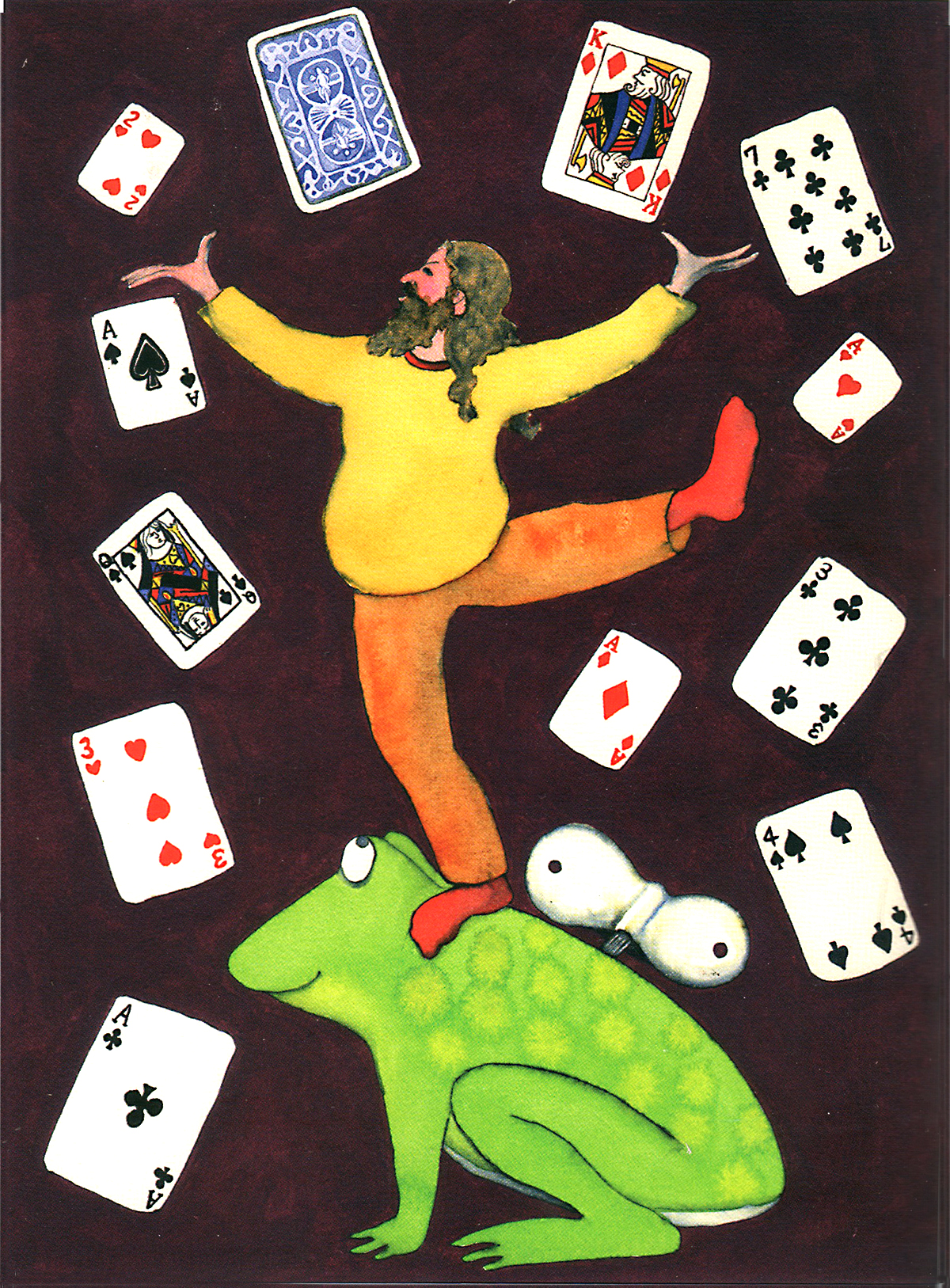
I joined some old friends on a different paint crew. We usually ate lunch at Noyes Lodge: a big cafeteria on the Cornell Campus. During lunch one day, I was introduced to Ricky, an eccentric magician with devilish smiling eyes. He sat hunched over his food, complaining that life was “a beating” and that he had no place to live. He carried on a rapid discourse about life and magic while constantly flipping a quarter smoothly and expertly over and under his fingers. Sometimes the coin disappeared into thin air, sometimes he magically retrieved it behind my ear.
I imagined what fun it would be to have a magician around the house and said, “You can stay at my house if you don’t mind kids.”
“I hate kids,” Ricky cackled,
“but I would love to stay there."
(Go to Story)